I'm a product designer who turns complex ideas into intuitive, engaging digital experiences. I combine UX thinking, visual design, prototyping, and creative technology to make products that are both useful and memorable.
I bring together product thinking, UX strategy, interaction design, and visual design to create intuitive digital experiences. My background in front-end development and illustration gives me a strong understanding of how both products are built and how they communicate.
Product Design
Designing usable, scalable product experiences across complex workflows.
UX Strategy
Turning ambiguity into clear structure, direction, and product thinking.
Visual Design
Crafting expressive interfaces with strong hierarchy and personality.
Creative Technology
Using code and emerging tools to push ideas beyond static design.
latest work.
A look at what I’m currently designing, prototyping, and building.
trace case study.
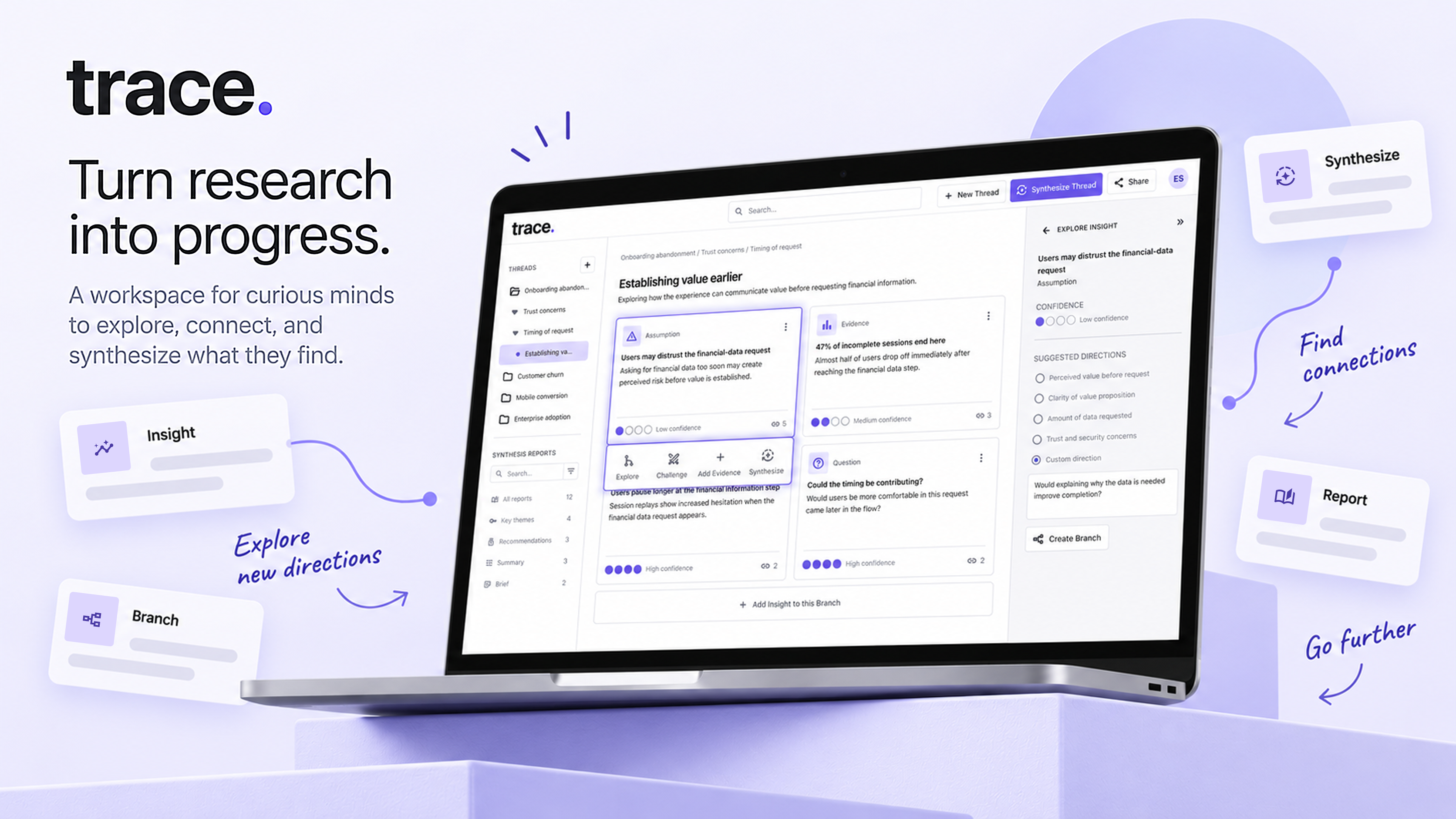
Turning scattered research into structured insights, connected branches, and actionable synthesis.
trace — case study.
Turn scattered research into structured understanding.
Trace is an AI research workspace designed for complex, nonlinear exploration. It helps researchers follow different lines of inquiry, preserve the context behind what they discover, and synthesize scattered evidence into clear insights.
One question leads to another. Evidence raises new possibilities, assumptions need challenging, and promising directions branch off from the original inquiry. As research expands, keeping those relationships intact becomes harder. Questions, evidence, and conclusions can quickly lose the context that connects them.
Trace explores how a workspace can support that process—helping researchers follow new directions without losing the reasoning behind how they got there.
02 — The design challenge.
How might we help researchers explore complex, branching questions without losing the relationships between what they discover?
The opportunity was to design a workspace that could support nonlinear thinking without becoming visually or structurally overwhelming. That meant making it easy to move between questions, evidence, assumptions, and conclusions while preserving the context of how each idea emerged.
03 — Trace's product model.
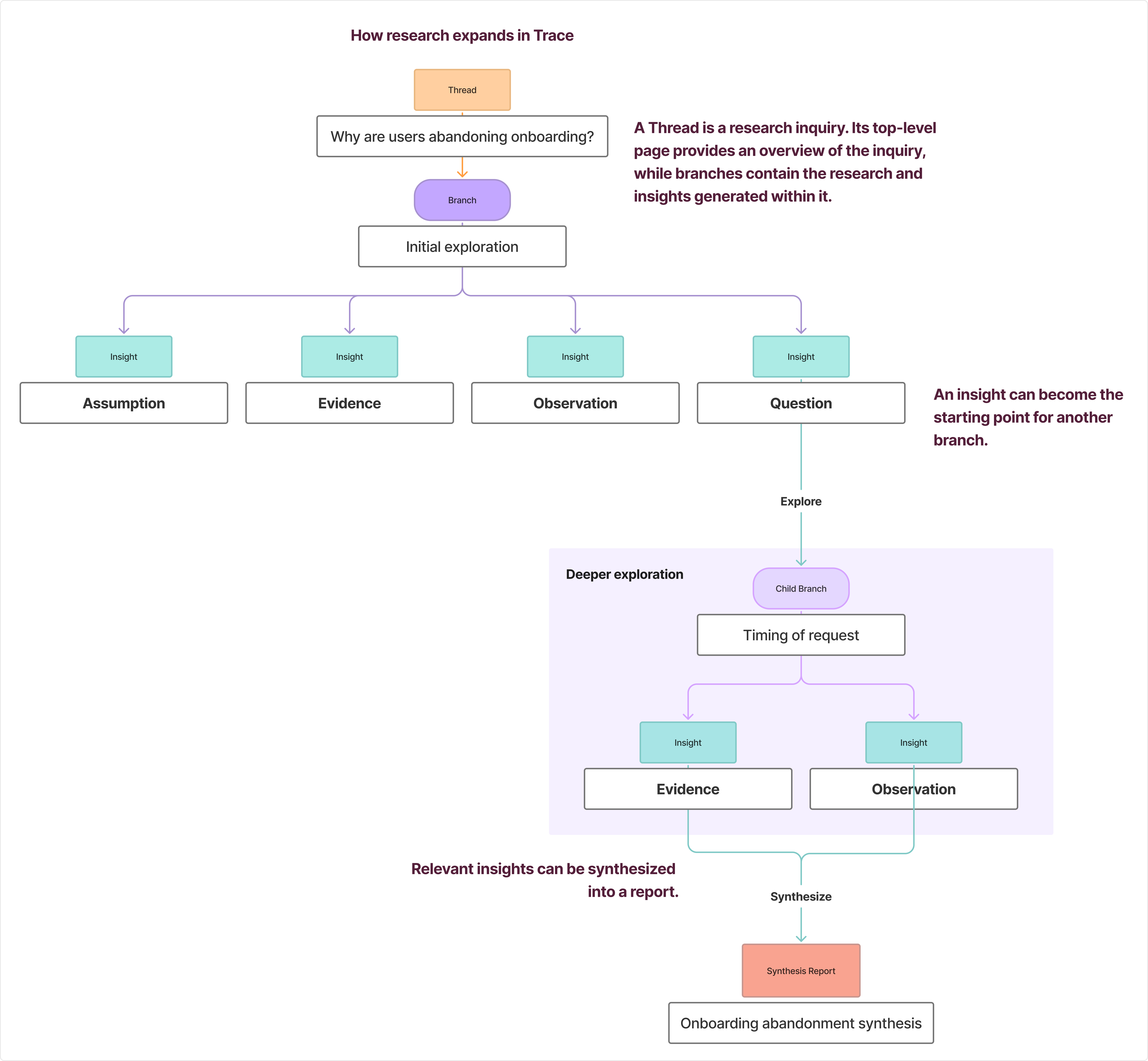
Trace organizes research around four connected layers: Threads, Branches, Insights, and Synthesis.
A Thread represents the broader research question or area of exploration. As new directions emerge, researchers create Branches to follow them without losing their relationship to the original inquiry. Along the way, findings are captured as Insights—including assumptions, evidence, observations, and questions. When enough context has accumulated, Synthesis helps bring those pieces together into a clearer understanding of what the research is showing.
Thread → Branches → Insights → Synthesis
04 — Designing for branching exploration.
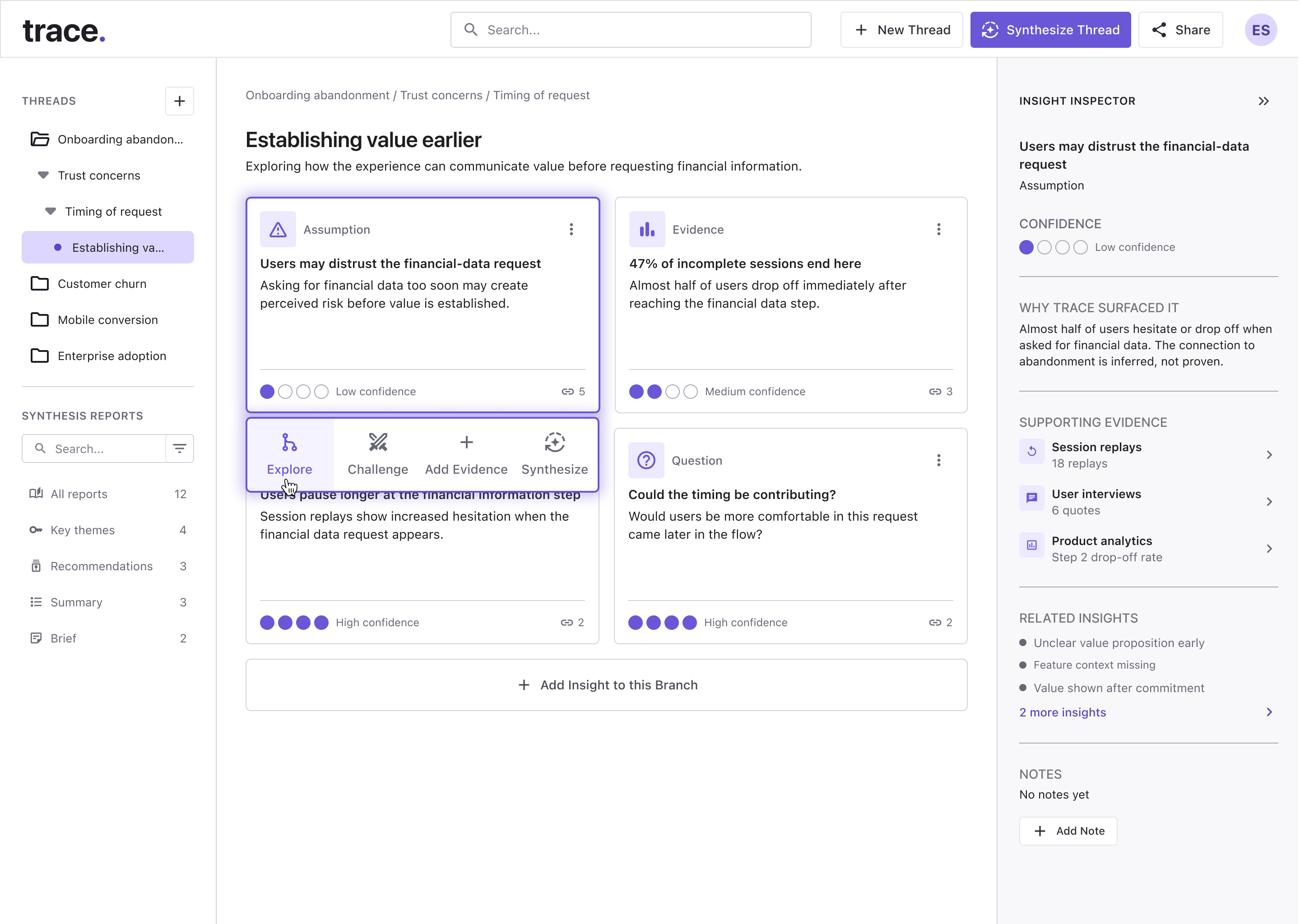
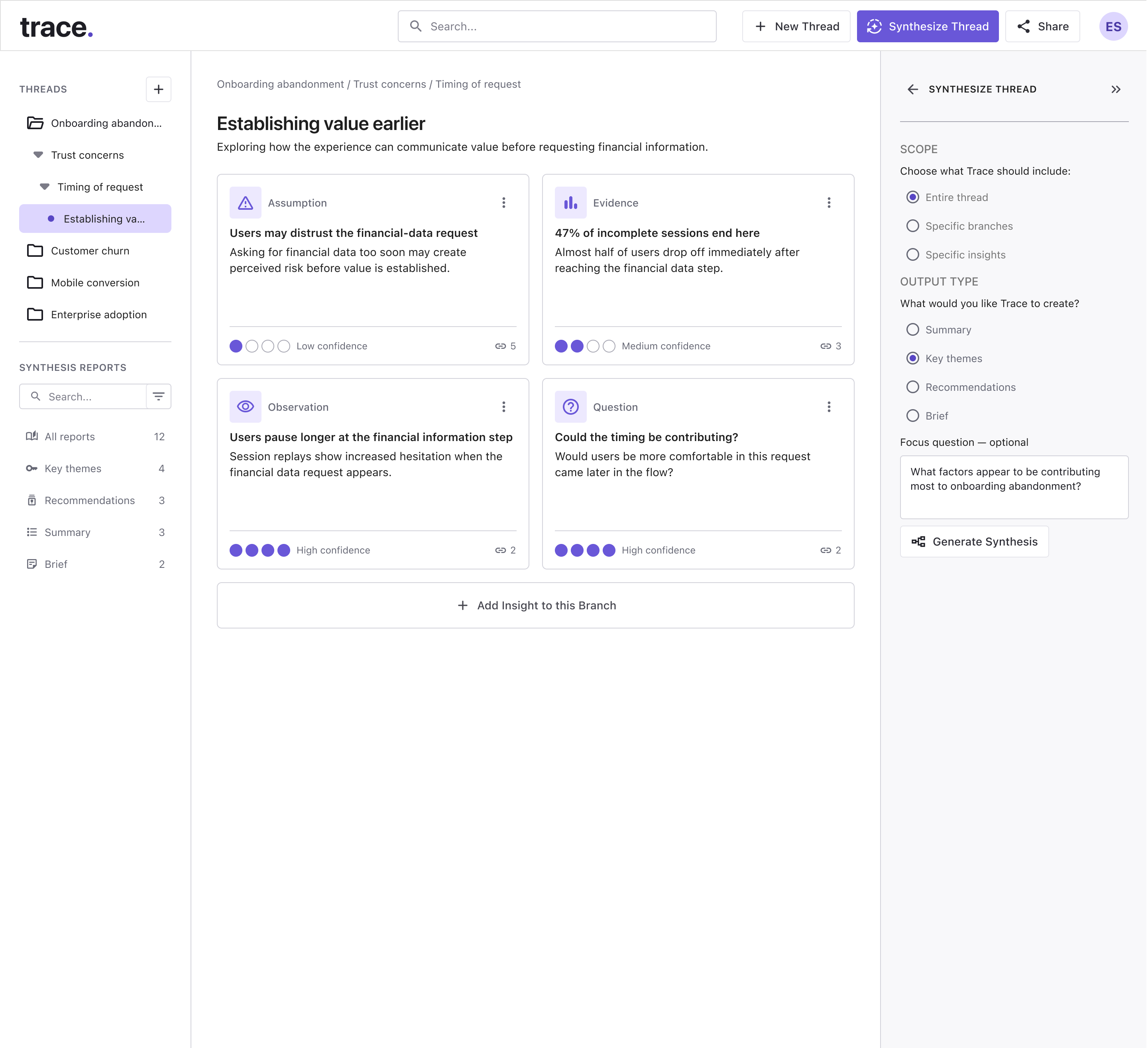
Trace needed to make complex research feel navigable without flattening it into a linear workflow. The workspace keeps the branch hierarchy visible while giving researchers a focused canvas for the insights within their current line of inquiry.
Selecting an insight reveals the context and actions around it without disrupting the surrounding work. Researchers can inspect supporting evidence, review related insights, challenge a finding, add evidence, synthesize it, or use it as the starting point for a new branch.
05 — Keeping research context visible.
As research branches into more specific questions, it becomes easy to lose track of how one direction relates to another. Trace keeps the active hierarchy visible in the sidebar so researchers can see the path that led to their current branch while still moving quickly between related areas of exploration.
The navigation uses progressive nesting and clear selected states to preserve context without forcing researchers to reconstruct the structure from memory.
06 — Turning insights into synthesis.
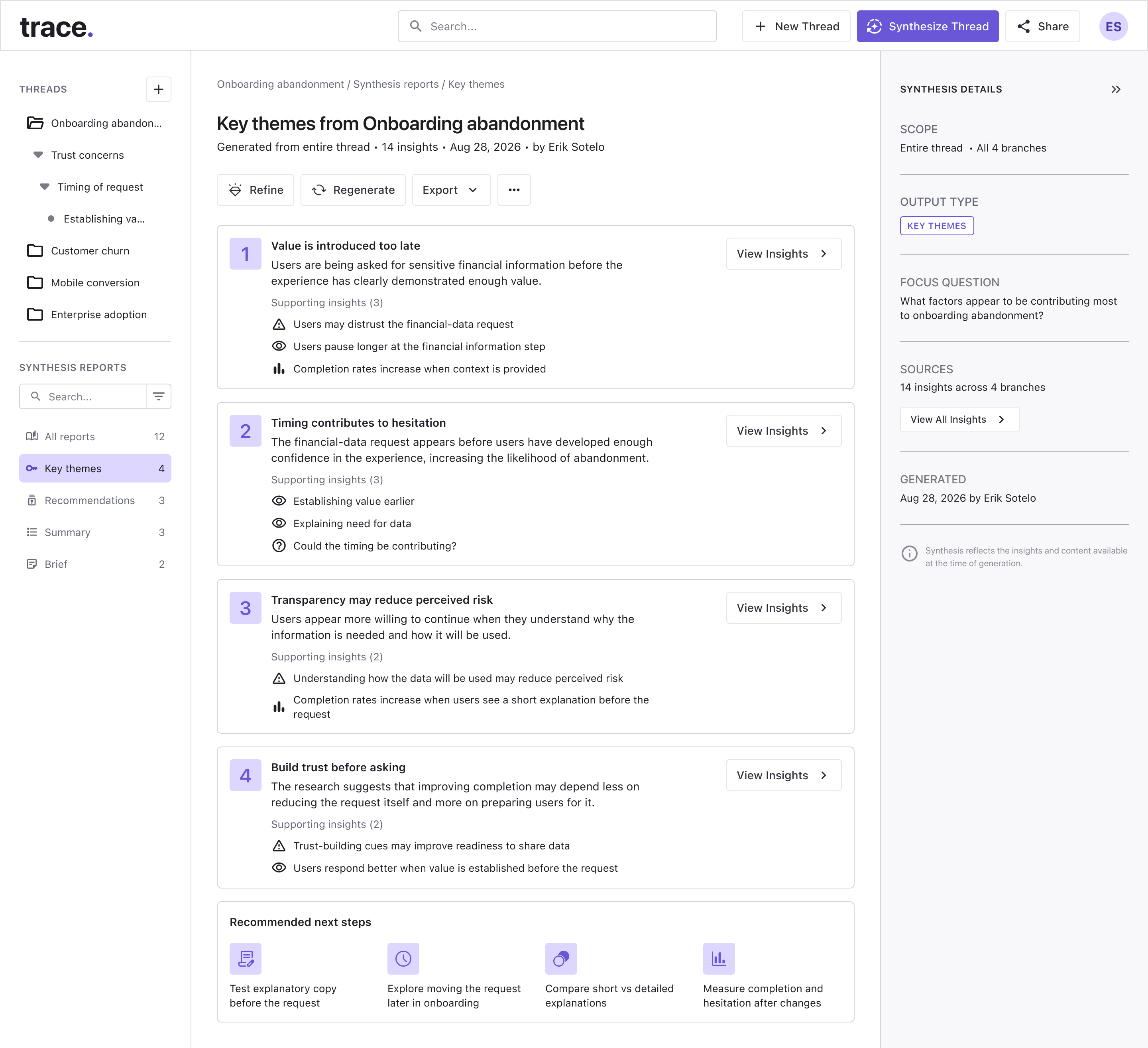
As research grows, the challenge shifts from exploration to making sense of what has been collected. Trace lets researchers select relevant insights across their work and bring them into a synthesis flow, where patterns, findings, and next steps can be organized into a report.
The goal was to make synthesis feel like a continuation of the research process rather than a separate task. Researchers can move from individual observations and evidence into a structured summary without losing the context behind those findings.
07 — Designing the report experience.
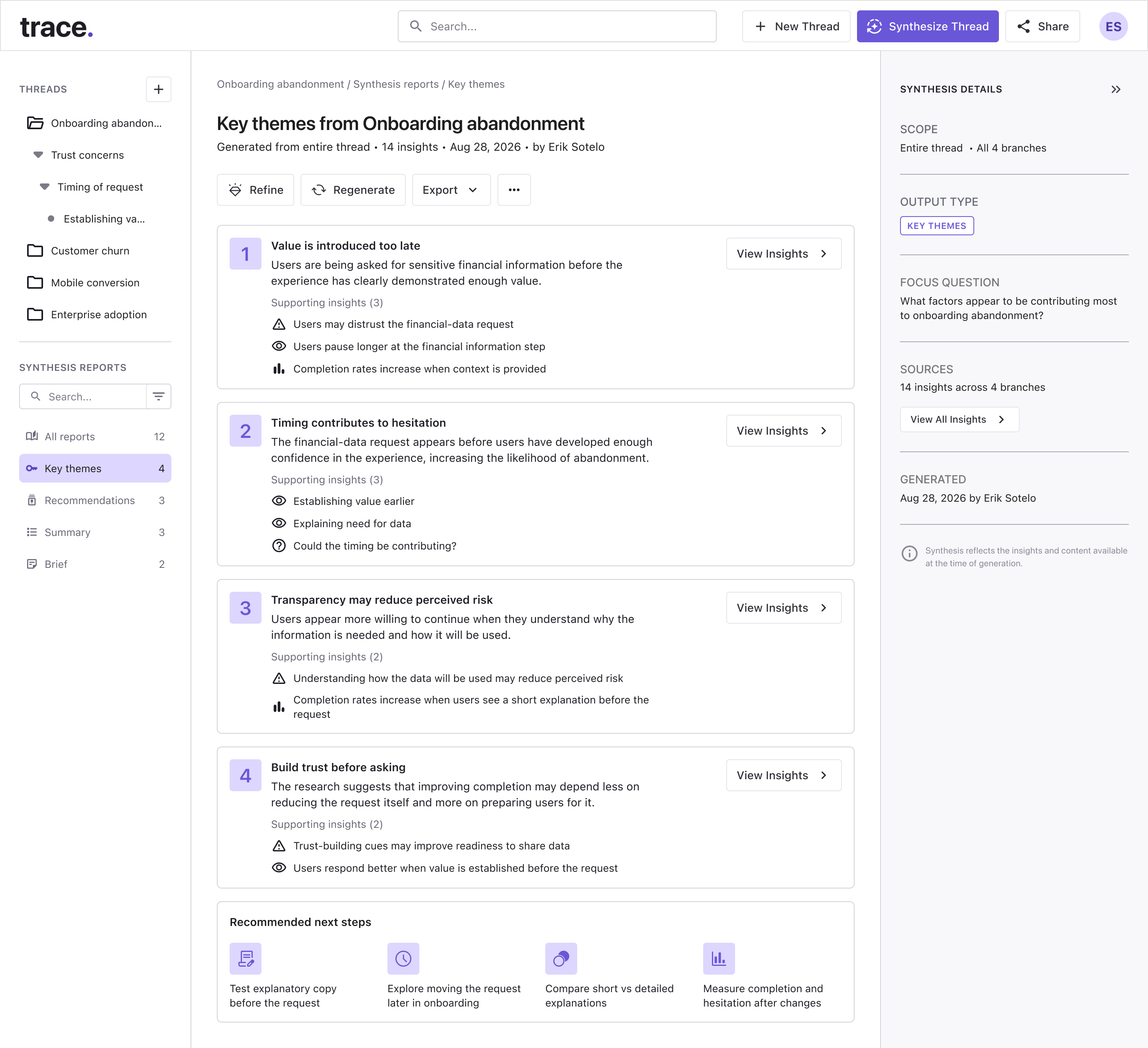
A synthesis report needed to do more than summarize findings. It had to preserve the evidence behind each theme while still making the output easy to scan.
I structured reports around thematic findings, supporting insights, and recommended next steps. Researchers can review the evidence behind each conclusion, refine or regenerate the output, and move from synthesis into action without losing the context that produced it.
08 — Reflection and next steps.
Designing Trace reinforced the value of prototyping the system, not just the individual screens. Building the product into a working Claude prototype helped expose interaction and navigation problems that were harder to see in static designs.
One of the clearest findings was the branch navigation model. The current sidebar works well for the depth explored in the case study, but as research continues to branch, deeper levels would need a more robust navigation solution to prevent the hierarchy from becoming difficult to scan.
If I continued developing Trace, I’d focus next on testing how researchers move through larger, more complex trees, refining the transition into focused exploration, and validating how much context people need to stay oriented as their research grows.
The next phase would also include usability testing around synthesis—particularly how researchers select source insights, understand AI-generated themes, and verify the evidence behind a report before acting on it.
contact me.
Interested in working with me? I'd love to chat! Send me a message and I will get back to you ASAP. Alternatively, I can be reached on LinkedIn, or Dribbble! Links are in the footer below.